How Science Got Lost
RCP8.5 and the Politics of Plausible Catastrophe

I have been thinking about the recent RCP8.5-related conversation not as a climate denial story or an argument against climate action, but as a case study in how science can sometimes get lost.
Not how science got lost because scientists are corrupt. Not how science got lost because models are useless. Not how science got lost because climate change is not real. Those are not the stories I am interested in.
The story I am interested in is this: how does science get lost when most of the people involved believe they are doing the right thing?
Let’s start this story from the beginning. RCP8.5 began as a high-emissions climate scenario. It was useful for asking what the world might look like under a severe emissions pathway. As a stress test, it had value. As a warning sign, it had value. But over time, it was turned into “business as usual”, representing the likely future absent dramatic policy action. That is the point Zeke Hausfather and Glen Peters made in Nature, arguing that the worst-case scenario should no longer serve as the default baseline, because better policy requires more realistic assumptions.
That distinction matters. A worst-case scenario is not the same as a baseline. A stress test is not the same as a forecast. A scientifically legitimate tool can become misleading when it moves from one context to another without the appropriate caveats.
That was 6 years ago, 3 years after Ritchie and Dowlatabadi showed that the underlying assumptions were no longer plausible.
That is where the RCP8.5 story becomes bigger than RCP8.5.
The Intergovernmental Panel on Climate Change was created in 1988 by the World Meteorological Organization and the United Nations Environment Program and has since become the central global body for assessing climate science for governments. But the IPCC was never simply a scientific academy. It was political by design, not partisan but intergovernmental. Its authority rests precisely on the hybrid arrangement between science and governments. That arrangement gives its assessments unusual power. It also makes boundary maintenance difficult.
The United States played a major role in creating and shaping this system. The U.S. came first before the UN, not the other way around. That history matters because it reminds us that climate science assessment was not born outside politics and later corrupted by it. It was built from the start as a mechanism for translating scientific knowledge into governmental judgment, and the U.S. was in the lead. That may have been necessary. It may even have been wise. But it also means that the relationship between climate science and climate politics has always required careful boundary management.
The problem is that, over time, managing that boundary became harder.
In the United States, science itself has become increasingly sorted by party. Dan Sarewitz warned more than fifteen years ago that the overwhelming Democratic identification among scientists was a problem because a scientific community so closely aligned with one political coalition becomes easier for others to distrust. More recent evidence points in the same direction: political donations by U.S. scientists have become overwhelmingly Democratic, with less than 10 percent of scientists’ federal campaign donations going to Republicans in recent years. That does not prove that science is wrong. It does suggest that the social location of science has changed.
Public trust data tell a similar story. The problem is not simply that Americans stopped trusting science. Trust remains fairly high overall. Pew reported in 2024 that 76 percent of Americans had a great deal or fair amount of confidence in scientists to act in the public interest. But the partisan gap is now large: 88 percent of Democrats expressed confidence in scientists, compared with 66 percent of Republicans.
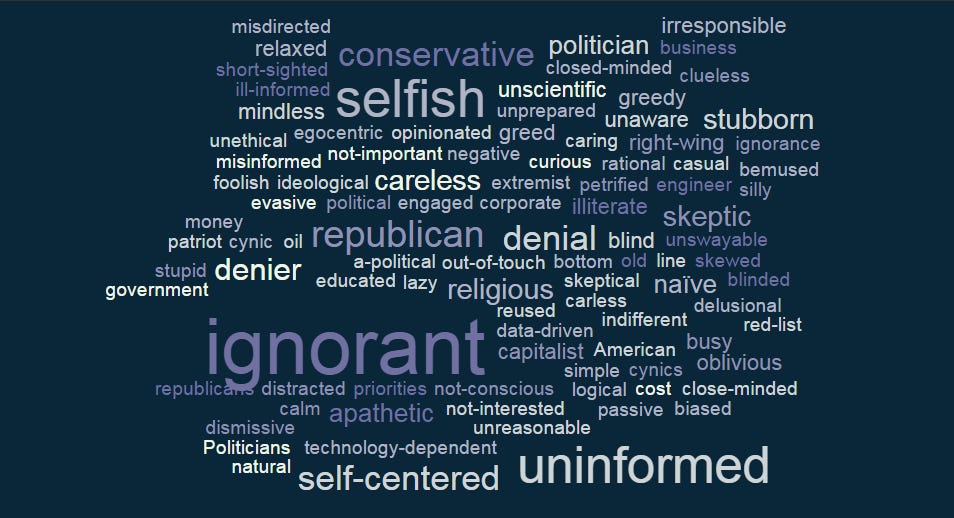
That is the crucial shift. The issue is not merely declining trust. It is a redistribution of trust. Science has not disappeared as a source of authority; it has become more politically legible. One side increasingly views science as part of its coalition, while the other increasingly views it as part of the opposing coalition.
Climate science sits at the center of this tension.
This is where I think the RCP8.5 controversy becomes especially important. It offers a concrete example of how a scientifically useful scenario can become politically useful in ways that make correction harder. A high-end scenario dramatizes risk, creates urgency for action, generates headlines, and supports a narrative that things are worse than expected, that time is running out, that compromise is dangerous, and that hesitation is complicity.
But what happens when the most politically useful scenario is no longer the most scientifically plausible baseline?
That is the uncomfortable question.
The answer, I suspect, is that correction becomes morally and politically costly. Calling RCP8.5 no longer “business as usual” could be seen as giving ground to climate skeptics. Saying that some emissions trends have improved relative to older worst-case assumptions could be treated as weakening the case for action. Calling for more realistic baselines could be mistaken for complacency.
So, the correction comes late. It comes after the scenario has already circulated through thousands of papers, news stories, risk assessments, advocacy campaigns, corporate disclosures, policy arguments, and campaign promises. Science eventually self-corrects, as it did in this case, but only after political usefulness has raised the cost of correction.
That may be the real lesson: science does not stop being self-correcting all at once. It becomes slower to self-correct in areas where correction is interpreted as betrayal.
This pattern is not limited to RCP8.5. Climate politics has repeatedly struggled to distinguish between evaluating options and morally disqualifying them in advance. Adaptation was once treated by some advocates as a dangerous distraction from mitigation, a moral hazard. It then became unavoidable. Nuclear energy was long resisted by many environmentalists, even though it is a low-carbon energy source. It is now being reconsidered in many circles of climate policy. Geoengineering, especially solar geoengineering, occupies the current version of this position: not simply an object of scientific assessment, but often a test of political loyalty.
None of this means adaptation is sufficient, nuclear is easy, or geoengineering is wise. Each raises hard questions. But that is precisely the point. The job of assessment is to ask those questions carefully, not to decide in advance which questions are morally admissible.
When science-policy communities treat some options as unspeakable, they make science less useful.
Roger Pielke Jr.’s experience is relevant here. He argued for climate action long before the activist community accepted adaptation. But he also challenged claims about disasters, damages, and the attribution of extreme events when he thought the evidence did not support the rhetoric. For that, he became, in his own account, a climate heretic. Whether one agrees with him on every point is not the issue. The issue is whether a healthy science-policy system can tolerate internal criticism without treating it as defection from the party of science.
A mature scientific culture should be able to say two things at once: climate change is real and serious; some claims made in the name of climate urgency are overstated, premature, or poorly supported.
If it cannot say both, it has a problem.
The Biden administration’s whole-of-government climate agenda may be another expression of the same difficulty. The problem was not the political aspiration. But combining climate policy, industrial policy, infrastructure deployment, and environmental justice into a single whole-of-government framework created an enormous implementation burden. It required federal agencies to move money, build projects, measure benefits, secure local legitimacy, and satisfy multiple political constituencies at once.
That is a difficult governance problem under the best conditions. Under polarized conditions, it becomes fragile. If projects are slow, if communities resist, if benefits are hard to measure, or if implementation becomes procedurally overloaded, the political coalition that created the program may have little to show by the time electoral politics change. Then programs that took years to assemble can be reversed quickly.
That, too, is a lesson about science getting lost, not because the science of climate change is wrong, but because the politics attached to it becomes overengineered, under-deliberated, and institutionally vulnerable.
So where does that leave the IPCC and RCP8.5?
I am tempted to say that the science-policy ecosystem helped create the conditions that allowed RCP8.5 to remain in use for too long. Not because anyone issued an order. Not because there was a conspiracy. But because the incentives aligned.
Researchers could publish high-impact risk studies. Journalists could tell urgent stories. Advocates could mobilize the public. Democratic politicians could justify ambitious policy. Agencies could plan for severe futures. And critics could be dismissed as undermining the case for action.
In that environment, the scenario did not need to be imposed. It only needed to remain in circulation.
That may be the subtler and more important failure.
Science gets lost when its tools are misused. It gets lost when caveats are omitted because they weaken the message. It gets lost when uncertainty is treated as a communications obstacle rather than a condition of honest assessment. It gets lost when politically convenient claims are defended longer than they should be because correcting them would help the “wrong” people. It gets lost when criticism from within the broad climate-action camp is treated as indistinguishable from denial.
And science gets especially lost when it forgets that public trust does not come from always sounding certain. It comes from being willing to correct oneself visibly.
The RCP8.5 debate should not be used to claim that climate change is exaggerated or that climate policy is unnecessary. That would be the wrong lesson. The better lesson is more demanding: climate action needs stronger science-policy boundary management, not looser standards in the name of urgency.
A democratic society needs climate science that informs action without blurring into climate politics. It needs scenarios that clarify choices, not those that quietly become slogans. It needs assessments that preserve the distinction among plausible futures, high-end risks, and mobilizing narratives. It needs scientists, policymakers, advocates, and journalists who can say: this risk is real, but this particular claim was overstated; this policy goal is worthy, but this implementation design is weak; this criticism is inconvenient, but not necessarily wrong.
That is not a retreat from climate action. It is a prerequisite for durable climate action.
The uncomfortable possibility raised by RCP8.5 is that the greatest threat to science in politics is not always an external attack. Sometimes it is internal over-identification: science becomes so attached to a political project that it loses the ability to discipline itself.
When that happens, science does not merely become politicized. It becomes vulnerable, making it an easy target for its opponents. It turns correction into a scandal and makes trust harder to rebuild, especially in an information environment without honest knowledge brokers.
The question, then, is not whether science and politics can ever be separated. They cannot, not fully. The question is whether we can rebuild the boundary practices that keep science useful to politics without making it captive to it.
RCP8.5 is a warning. Not the warning it was often used to deliver, but perhaps a deeper one: even good science can be lost when its political usefulness outpaces its epistemic care at the boundaries of science, policy, and politics.
I appreciate your nuanced take regarding science and politics. The idea of managing the boundary between them provides a good frame of reference. And I especially enjoyed the ending - don't avoid difficult questions or omit inconvenient facts just to preserve the illusion of certainty.
Well said. Bravo!
Why not tell it like it is? Climate “Scenarios” are actually Climate GUESSES.
.
The guesses may be computer-generated, but they are still guesses.i